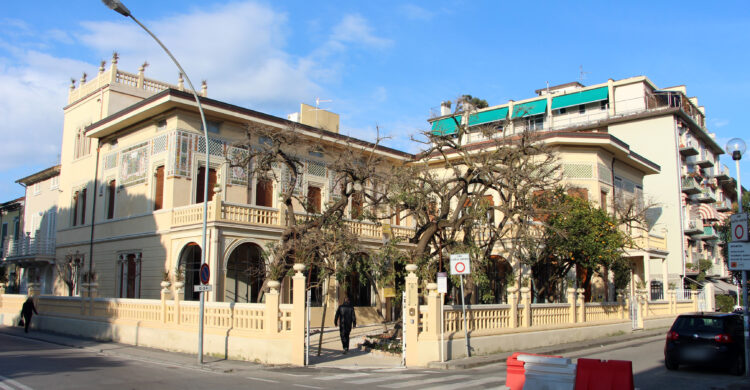
Villa Argentina is an elegant residence located in via A. Fratti at the corner with via A. Vespucci, 44-400 in Viareggio.
History
The building was erected in 1868 in a vast garden located in via A. Fratti, at the corner with via A. Vespucci, in the residential area known as the “four winds” of Viareggio.
In 1926, the architect Alessandro Lippi carried out the expansion and restructuring project, while the painter Galileo Chini intervened with numerous decorations both external and internal, which characterize the facades along the first floor, and are perhaps the most extensive and representative of the his work, with panels with geometric motifs that alternate with anthropomorphic and floral decorations clearly inspired by the Neo-Renaissance; in a very interesting succession from a compositional and chromatic point of view. In the realization, the search for the tradition of Florentine glazed ceramics is clear, even if through the use of metallic luster effects it gives a modern aspect to the work, which blends the late liberty with the Renaissance in a harmonious and elegant whole. These decorations differ from those created by Chini for the “Berzieri” baths in Salsomaggiore, due to a clearly neo-Renaissance stylistic choice compared to the more ecliptic-liberty experiments of the spa.
Subsequently, the villa was transformed into a hotel and therefore underwent an expansion in the rear part to the north, until the façade overlooked via A. Fratti, in adherence to the already existing one.
The architectural forms taken on by the expansion take up the characteristics and typology of the existing building, however without ceramics or decorations on the facade, while the turret with a view towards the sea represents the most significant element of the new building, dating back to 1938.
Also inside the villa, Galileo Chini certainly worked, especially in the main hall on the ground floor, where rich oriental stucco decorations covered with gilded silver leaf using the Florentine mecca painting technique, complement the large wall painting by G. Biasi, made in the 1920s and entitled “Matrimonio Persiano”.
Description
Located on the edge of the western pine forest, it takes on the characteristics of an “urban villa in Viareggio, mediating the forms of the city palace and the country residence. With the palace it shares the position aligned on one or more street fronts, with the villa the individuality of the building and the search for an exclusive relationship with the surrounding buildings and with the greenery” On 23 October 2000 in Rome a Protocol of Understanding was signed for the purchase, restoration, enhancement and management “Villa Argentina” in Viareggio (LU) between the Ministry of the BBAACC represented by the Undersecretary of State Hon. Carlo Carli, the Province of Lucca represented by the President Andrea Tagliasacchi, the Municipality of Viareggio represented by the Mayor Marco Marcucci. With this memorandum of understanding, the Province undertakes to purchase the complex by February 2001; the Ministry undertakes the restoration, functional adaptation and enhancement for a total amount not exceeding three billion lire; the Municipality of Viareggio undertakes to transfer the Centro Liberty to the premises of the Complex. Ministry, Province and Municipality agree that the Complex will be used: 1) Palace of Tourism and Culture; 2) Liberty Center of the Municipality of Viareggio. After a very long period of work (with suspension and interruption) on 23 November 2014, by the Province of Lucca (which became the owner of the Complex) and in front of a large festive crowd of citizens, the Complex of Villa Argentina was inaugurated as a historical asset public art.
The Villa has been active and flourishing as a hotel facility for many years, enjoying an excellent position due to its proximity to the sea and the western pine forest which is opposite immediately across the road.
Entirely fenced off on the street sides, with a low plastered wall surmounted by modular concrete elements punctuated in a regular manner by small pillars on which ornamental vases rest, the main entrance to the villa is located on the corner between the two streets, while on via A. Vespucci there is find the secondary one and the driveway that leads to the internal courtyard. The garden is in a state of absolute decay, due to the total abandonment of the arrangements and plants present.
The original part of the villa, that is the one built in 1868, rises on two floors above ground, while the extension, in addition to the two floors connected to the pre-existing body, also houses an additional attic floor. Together with the enlargement, the total restructuring that the architect. Alfredo Belluomini and Galileo Chini conceived in those years. The denomination “Villa Argentina” appears for the first time, as a tribute to the then owner Francesca Racca Oytana of Argentine origin, in 1926 on the project to expand the property.
Worthy of note is the portico on the ground floor, once open and later closed with glass windows, due to the functional needs of the hotel business. With the terrace overlooking which the rooms on the upper floor overlook, it forms a linking motif between the old and the new and a volumetric balance that characterizes the corner position of the villa.
Placed externally along the elevation of the first floor, the decorative panels elaborated by Galileo Chini alternate with the geometric checkerboard ones placed above the openings, and with those with figures of naked cupids. The largest and most representative panel, which highlights the originality of Chini’s work, is placed between the two windows of the façade facing via Fratti. Internally, the internal hall with wall decoration by Giuseppe Biasi made in the 1920s is significant.
In the east elevation, on the edge of the property, where the driveway is, there is a small stained glass window on the ground floor bearing the initials “S and C”. By decree dated 23 June 1989 of the Minister for Cultural and Environmental Heritage, Vincenza Bono Parrino, the property called “Villa Argentina” was declared of particularly important interest pursuant to law 1 June 1939 n° 1089.