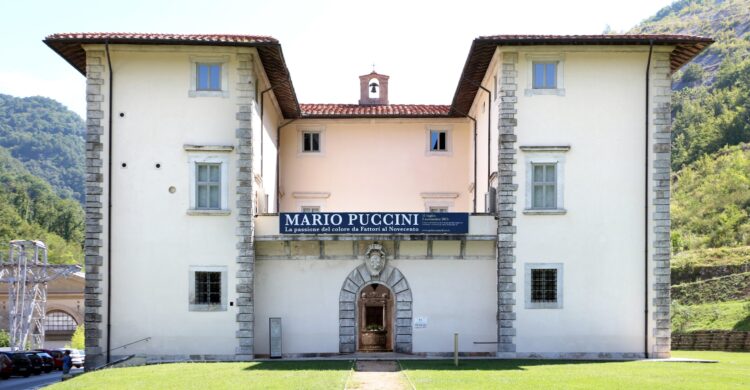
The Medici palace of Seravezza is the venue for events and temporary exhibitions.
On 23 June 2013, the Medici palace was officially recognized by UNESCO as a World Heritage Site in the “Serial site of Medici villas and gardens in Tuscany”.
The modern facade is actually the back of the building which leads to the Medici stables. The original entrance is sealed today and is located where the children’s library is now. Above it is possible to notice an engraving in Latin in honor of Francesco De’ Medici.
The villa was built by Cosimo I between 1560 and 1564, based on a project by an unspecified architect: it is attributed by some to Bartolomeo Ammannati, by others to the young Bernardo Buontalenti (given some similarities with the villa of Artimino).
The Seravezza area was of great strategic importance for the possession of Versilia: disputed for centuries between the Republics of Pisa, Lucca, Genoa and Florence itself, with the advent of the Medici grand-ducal government (1513), Cosimo took care as soon as possible to place a tangible outpost of his domain, at a border point. In fact, if necessary, the villa could become a defensive military outpost, as can also be seen from its solid and compact structure with corners like a fortress and loopholes on the ground floor.
However, this did not penalize the stately and leisure dimension of the residence, as can also be seen from the lunette by Giusto Utens in the Topographical Museum of Florence as it was in Florence, with the large woods in which hunting was practiced, a vegetable garden and a geometric Italian style, a chapel and a building used as stables. Furthermore, the nearby bank of the Vezza river provided a cool breeze, making holidays pleasant especially in the summer months, when it was the usual destination for the stays of various characters from the Medici court. Among the guests who spent particularly long periods there are Bianca Cappello, second wife of Francesco I de’ Medici, son of Cosimo, and Cristina di Lorena, who resided there for long periods after being widowed by Ferdinando I, brother and successor of Francesco (16th-17th century).
The Seravezza area also had another important strategic feature, namely its proximity to the quarries and mines that Cosimo I wished to develop. The marble and silver quarries had been inactive for some time, but the grand duke gave new impetus to the mining activity both after the discovery of veins of silver-bearing lead and, from 1563, of the “mistio” marble also known as “fior di pesco” or “breccia of Seravezza”, which became much in demand for its value. From his villa in Seravezza, Cosimo thus had the opportunity to closely follow the mining activity, which he himself had relaunched.
The villa passed to the Lorraines with the extinction of the Medici family (18th century). The Grand Duke Pietro Leopoldo assigned a part of the premises for the warehouses and administrative offices of an ironworks, still visible to the side of the building, built around 1786 along the Vezza stream. In 1835, when the ironworks closed, the villa returned to being a place of residence for the grand ducal family. It then passed to the Italian State and in 1864 it was donated to the municipality of Seravezza which, after having initially used the building as a prison, recovered it and later used it as the Municipal headquarters, until 1966. Today it houses the Museum of Work and Popular Traditions of Historical Versilia, the “Sirio Giannini” municipal library, the historical archive and exhibitions of modern and contemporary art.
The Museum of work and popular traditions of historic Versilia
The Museum was opened to the public in 1996 and traces the productive activities of the area and their historical evolution. First of all, the marble extraction industry, from the nearby quarries of Monte Altissimo, which is documented by a series of tools, machines and machine models on the excavation, transport and processing techniques practiced in the area.
Another important activity restored by the Medici was that of the extraction and processing of metals, of very ancient origin, such as the working of iron, which is documented through some tools used in the ironworks and in the artisan workshops.
There are also objects related to other domestic activities, such as weaving, and various agricultural tools both for the cultivation of mountain and flat land. There are numerous photographs and fact sheets that illustrate didactically the function of the various objects on display.
The work tools are displayed in eleven rooms and can be dated between the end of the eighteenth century and the mid-twentieth century.
Municipal library
Since 1984 the Sirio Giannini Library has been transferred to the ground floor with assets of approx. 30,000 units; subsequently the Historical Archive was also transferred to the same location