
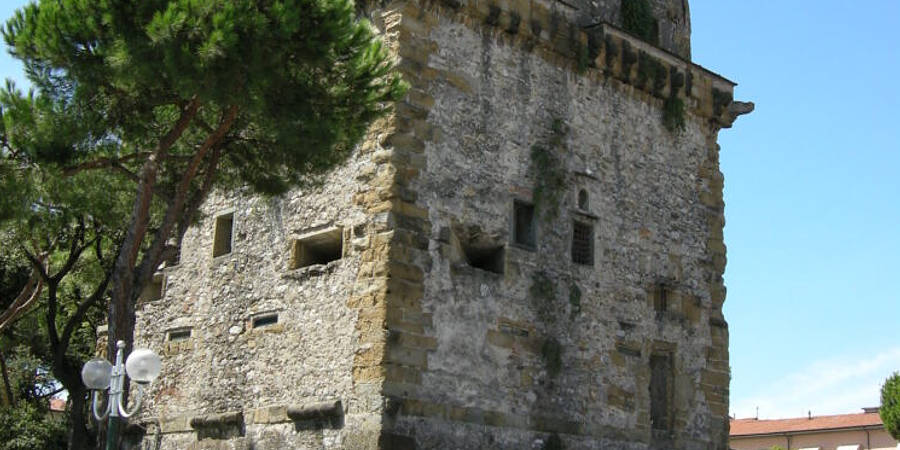
Torre Matilde Via Nicola Pisano, Viareggio ,
The Matilde tower is a tower in Viareggio, an example of 16th century military architecture. It is called “Torre Matilde” due to the erroneous attribution of its construction to Matilde of Canossa.
History
Following the advancement of the coast line, the castle of Viareggio (castrum de via regia, built in 1172 and the only access to the sea of Lucca from 1441 with the landing place of the mouth of the Selice, current Burlamacca canal) was in fact about 600 m inland and was no longer effective in protecting the landing place on the coast, exposed with its warehouses to attacks by Barbary pirates. The government of Lucca therefore decided to build a tower on the sea on 5 June 1534.
The construction of the new tower was carried out using as material the squared stone blocks that could be obtained from the partial demolition of the old castle. To finance the work it was decided to tax the goods arriving in Viareggio with some extraordinary gabelles for six years. Tommaso Montecatini, Jacopo Arnolfini, Martino Bonvisi, Bernardino Cenami, Filippo Calandrini and Francesco Balbani supervise the works. From its summit, the arrival of Emperor Charles V was greeted with blank shots, who landed in Viareggio to meet an emissary of Pope Paul III in Lucca between 12 and 18 September 1541. The construction was completed in 1542 and in 1544 a fortification wall of the village of Viareggio was added, built around the landing place. A garrison of fifteen men was installed there. In 1546-1549 the residence of the “beach commissioner” was built next to it, in charge of controlling the village and the movement of goods. The residence was connected to the tower by means of a loggia.
At the beginning of the 17th century the tower was raised by one floor and surmounted by a small bell gable in which two bells were housed.
After 1703, the public clock on the facade of the beach commissioner’s house was moved to the top of the tower. Initially, a local inhabitant was entrusted with its operation, paid by the community through an annual fee of four sous per family; in 1748 the task passed to the guard soldiers.
On 15 April 1780, the tower was struck by lightning, which killed a soldier on guard duty, but spared the nearby gunpowder depot. In thanksgiving for the narrow escape, the “Voto del comune” festival was instituted, suppressed in 1808 and restored in 1821.
Following the further advancement of the coast line, the mouth of the Selice was regularized with the construction in 1788 of the Burlamacca canal, next to which a new fort was built, the Fortino sulla Foce di Viareggio. However, the tower maintained its function as a surveillance post, for sighting both any enemies at sea and fires; the bells were also used to summon the community parliament.
At the beginning of the 19th century the tower was used as a prison, in particular for prisoners in transit and in 1810 a telegraph tower was installed there. In 1813, the British landed in Viareggio and occupied Lucca to retreat again on ships following the arrival of the French, without the garrison of the tower being able to offer any resistance. Commander Ippolito Zibibbi was sentenced to death, with the sentence later changed to life imprisonment, due to the lack of defense. The episode highlighted the poor effectiveness of the tower as a military garrison and in fact remained only as a prison. In 1810, a semaphore signaling point “il telegrafo” was installed on the tower. In 1819 Viareggio was given the title of city and prisoners and convicts, also housed in the tower, lent their work for the construction of the dock. Between 1823 and 1847 the tower was used as a “bathroom for convicts”, while the actual prison was transferred to Camaiore. In 1850 it was used again as a prison and in 1854 the house for the caretaker was built next to it. The tower housed 6 cells each of which could accommodate up to six inmates. It maintained this function until the Second World War.
Once the prison was abolished in 1945, the tower remained closed and abandoned until 1969, with the first restoration works being carried out by the Superintendence for Environmental, Architectural, Artistic and Historical Heritage of Pisa. The restoration works were resumed in 1975 and were concluded in 1982, allowing the original structure of the monument to be brought to light, altered by the numerous works of adaptation of the internal spaces to the various functions. The tower currently hosts cultural events and art exhibitions.
Find Tourist Attractions